From our archives. Published on 29.03.2011. Dates, figures and circumstances refer to this historical account.
Location of the development
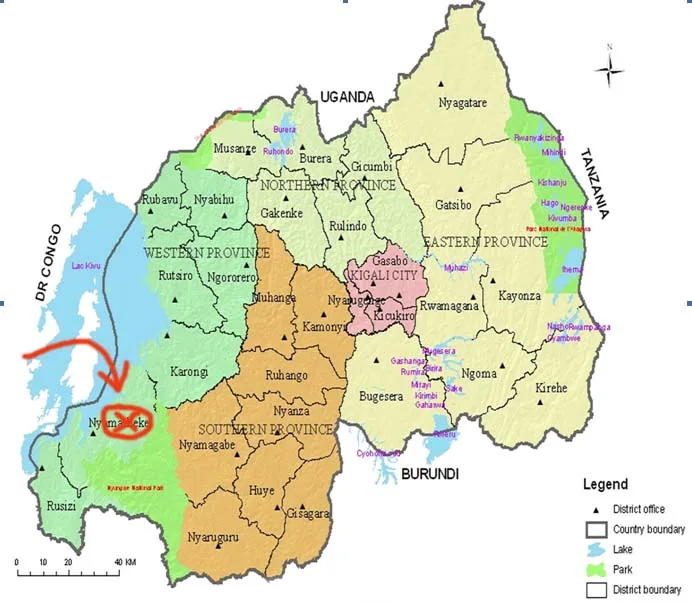
The site is in Bushekeri, near Nyanza in the Nyamasheke district, not far from our school.
Access road
Because the project is in a remote area with difficult access, a road will be needed. The distance from the main road to the site is around three kilometres, along a path covered with wood, stones and weeds. Even a red-earth road will need to be built before construction so that materials can reach the site.
Setting and surroundings
The area was badly affected by the 1994 genocide. It is densely populated, very poor, far from a large town and reliant on agriculture. The nearest school is ten kilometres away, a journey made on foot because there are no buses or cars. There is no nearby health centre either.
Because the site is isolated, it needs to be made as safe as possible. A nursery and primary school are planned for children living in the village and the surrounding area.
Our approach
The association has decided to protect children at risk, keep siblings together, offer stable long-term care, and support their transition into adult life.
Children’s rights
Children have the right to a safe home, an education and a say in decisions affecting them. They need special protection and assistance. The United Nations adopted the Convention on the Rights of the Child in 1989. Its guiding principles provide a framework for interpreting, implementing and monitoring children’s rights.
Its 54 articles include the rights to equal treatment, medical care, education, play and leisure, non-violent upbringing, freedom of expression and participation, protection from economic and sexual violence, protection during war and displacement, and suitable support for children with physical, mental or social disadvantages. Children also have rights to a name, a nationality, family ties, freedom of religion and an adequate standard of living.
Who would the village welcome?
Children aged two and over, including siblings, who have lost their mother, face serious mistreatment or have been abandoned. The intention is to care for children at serious risk who cannot be supported elsewhere.
How many children?
The initial limit is 100 children so that the project can begin properly and develop gradually. A later extension to 150 could be considered. More would create difficulties in management and individual care.
How would children be admitted?
Following a request from a family or local authority, an admissions committee would examine the case. This assessment is essential: once a child enters our care, they should be able to remain until adulthood. Careful selection criteria are therefore necessary.
What kind of home?
We favour a family-style approach, consistent with the Rwandan government’s preference for foster families rather than conventional orphanages. The SOS Children’s Villages model provides a useful example for children to grow up in a more supportive setting.
The plans include family homes, each for ten children and a substitute mother; a building with kitchens, a dining room or restaurant, and a study and reading room; accommodation for the sisters; an administrative building; a nursery; a primary school; and a health centre.
Other facilities
Alongside the homes and administration buildings, the site is to include a kindergarten, a medical centre as a key part of the project, and a chapel.